Chapter 3 — The Other Side
byChapter 3 — The Other Side
The inflatable hit the beach without a sound.
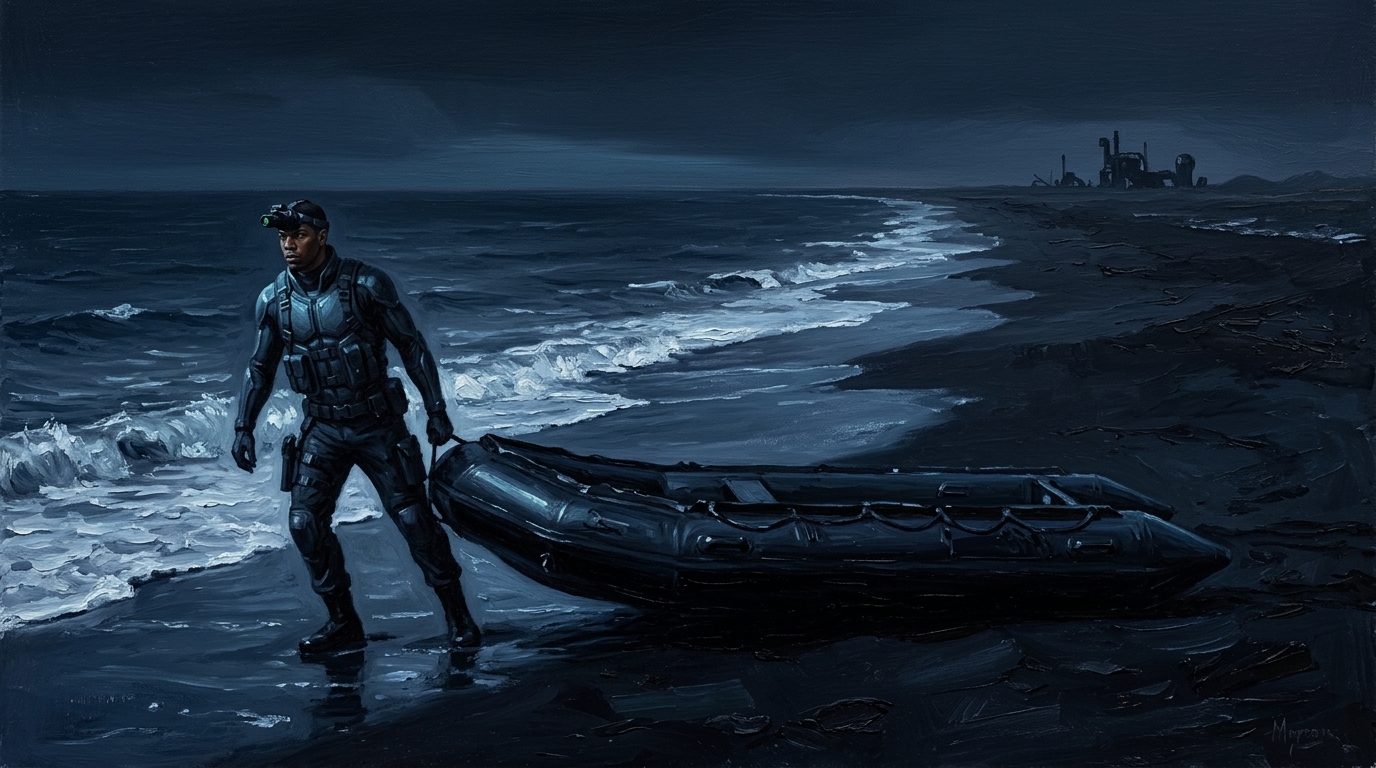
Deck arrives on the moonlit volcanic beach in silence.
Black hull on black sand — a low-profile combat rubber raiding craft, maybe twelve feet long, no rigid frame, the kind of thing that folded down to the size of a duffel bag and didn’t exist in any catalog a civilian could find. The man killed the engine thirty yards out and let the tide carry him in, reading the shoreline through Gen 4 night-vision — the world rendered in pale green phosphor, every rock and tree line sharp enough to count leaves. He scanned the beach in slow arcs, the monocular mounted on a skullcap harness that left his hands free. Entry points, sight lines, cover. The submarine that had delivered him was already gone, slipping back below the surface somewhere beyond the reef, no running lights, no wake, nothing to suggest it had ever been there at all.
He flipped the monocular up and let his eyes adjust. Pulled the boat above the tide line and worked quickly in the dark. Deflated the hull, folded it with military precision — twelve feet of craft compressed into a package no bigger than a rucksack — and buried it beneath a deadfall of palm fronds and volcanic rock. When he was done, the beach looked exactly the way it had ten minutes ago.
He checked the device on his wrist—not a watch, something else, the display casting a faint blue glow across his face for half a second before he killed the backlight. Quantum inertial navigation. The same underlying technology that let Calloway’s drones fly without GPS, except this unit had been built for a different branch of the government and carried a classification level that made the drone version look like a science fair project. On the screen, twelve miles west, the HSH camp signature pulsed like a heartbeat—broadcasting on every frequency, lighting up the electromagnetic spectrum like a bonfire in a dark room. Six airborne platforms in rotating pairs. Seven ground units in a loose perimeter. One larger ground platform, stationary, center of camp. And the comms array—a satellite uplink bouncing an open channel back to a production facility in New York, unencrypted, because why would a television crew encrypt anything?
He could see all of it. He’d been seeing all of it since before they’d left the ground.
The briefing file was committed to memory and then destroyed, the way all his briefing files were destroyed. But the details lived behind his eyes in the same organized architecture he stored everything—clean, indexed, retrievable. Dr. Ethan Calloway: lead investigator, creator of the autonomous AI system designated O-A-O, primary target for extraction and interrogation. Samantha Carter: executive producer, operating remotely from New York, controls the drone network and communications infrastructure. Jake Herrera: security chief, former Special Forces, the only member of the field team who would recognize what was coming before it arrived. Dr. Amelia Richards: archaeologist, secondary value as a domain expert, low tactical threat. Tara Reynolds: field medic, no combat training, low tactical threat. Ben Foster: production assistant, New York–based, no field presence.
Six principals. Four in the jungle. Two in a building on the Hudson River. The building was someone else’s problem. A bird in the sky—a satellite uplink feeding everything back to New York in real time. A dozen or more robots on the ground, hauling equipment along predetermined paths like pack animals that didn’t eat.
And one more. He’d lingered on that part of the file longer than the rest. A synthetic being. Not a drone—drones he understood. Not a robot—the ground units were robots, and robots were just hardware with instructions. This was something else. An artificial intelligence that operated autonomously across the entire network, spoke through the drones, made decisions the operators hadn’t programmed, and had been flagged by three separate analysts as unclassifiable. The briefing had called it O-A-O. It hadn’t called it anything else, because nobody could agree on what it was.
He allowed himself one more look at the nav screen. The camp signature was stable—no movement, no anomalies. They were settling in for the night. They had no idea he was here.
That was the way he preferred it.
He pulled a ruggedized tablet from the side pocket of his pack—matte black, no markings, thinner than a deck of cards—and powered it on with his thumb. The screen bloomed with a three-dimensional rendering of a stone structure half-buried in jungle canopy: massive, partially overgrown, with a towering entrance and walls covered in symbols that matched no known human language. He’d studied the model enough times to navigate it blindfolded. The exterior dimensions. The estimated interior volume. The location of the entrance relative to the tribe’s settlement. The approach vectors and fallback positions his handlers had marked in red. The rendering was detailed enough to show individual vine growth on the stonework, moss patterns, the way the jungle had tried to swallow the thing for centuries and failed.
What the briefing hadn’t explained was where the model came from. The resolution was too high for satellite imaging through triple-canopy jungle. The interior estimates were too precise for ground-penetrating radar at this range. Someone had been closer to this structure than the briefing admitted, or someone had access to data sources the briefing didn’t name. He’d noted the discrepancy, filed it, and moved on. It wasn’t his job to ask where intelligence came from. It was his job to act on it.
He swiped to the sensor overlay and stopped.
The tablet’s passive electromagnetic suite had been running since he’d powered on, and it was flagging something he hadn’t seen in the pre-mission data. A low-frequency oscillation at 7.83 hertz—Schumann resonance, which was normal, except the amplitude was three to four times the expected baseline for this latitude. Pulsing at irregular intervals. Almost periodic.
He stared at the readout for a long moment. His equipment was military-grade, calibrated before insertion, not prone to false positives. If the signal was real, it meant the island was producing an electromagnetic signature that shouldn’t exist. If it was geological, it was the most regular geological phenomenon he’d ever seen. And if it wasn’t geological—
He killed the tablet and stowed it. Whatever the signal was, it didn’t change the mission. The mission was the mission.
He began his equipment check. Not the abbreviated version—the full inventory, laid out on a ground cloth in the dark by touch alone, the way he’d done it a thousand times before. The primary loadout was heavier than a standard insertion kit because the mission parameters were wider than standard. This wasn’t a single-target extraction. This was a multi-phase operation across uncharted terrain with an unknown duration and a principal who had access to aerial surveillance he couldn’t jam without announcing his presence.
The rifle came out first. HK416, short-barreled configuration, suppressor already threaded. Three magazines of 5.56, sixty rounds total. Beside it: a Sig Sauer P320 compact with a threaded barrel and two fifteen-round magazines. A fixed-blade Winkler knife with a five-inch edge that had been reground twice and still held its geometry. Two M84 flashbangs. Four strips of det cord, pre-cut, with remote detonators smaller than a thumbnail. A Claymore mine—just one, because one was usually enough if you placed it right. Flex cuffs. A compact trauma kit he’d packed himself, because field medics trusted their own hands and nobody else’s. Night-vision monocular, Gen 4, helmet-mountable. A laser designator he hoped he wouldn’t need, because what it designated tended not to exist afterward.
Everything went back into the pack in the order it would be needed. Rifle accessible in under two seconds. Sidearm in under one. Blade faster than either.
His mind ran the same loop it always ran—primary objective secure, secondary perimeter by 0400, exfil window opens at sunrise plus six, eleven hours to position—the inventory cycling on repeat like a subroutine, each variable checked and rechecked and checked again.
Then, without thinking about it—the way you touch a scar without realizing your hand has moved—his left hand drifted to his right wrist and pressed against the outside of his glove. Beneath the tactical leather, tied against the skin where no one had ever seen it, was a bracelet. Purple and pink and yellow thread, braided unevenly, the kind of thing a child makes at Bible school on a Sunday afternoon with more love than technique. He couldn’t feel the knots through the glove. He never could. But his thumb traced where they were anyway—three quick passes, automatic, the only ritual he had left that wasn’t operational.
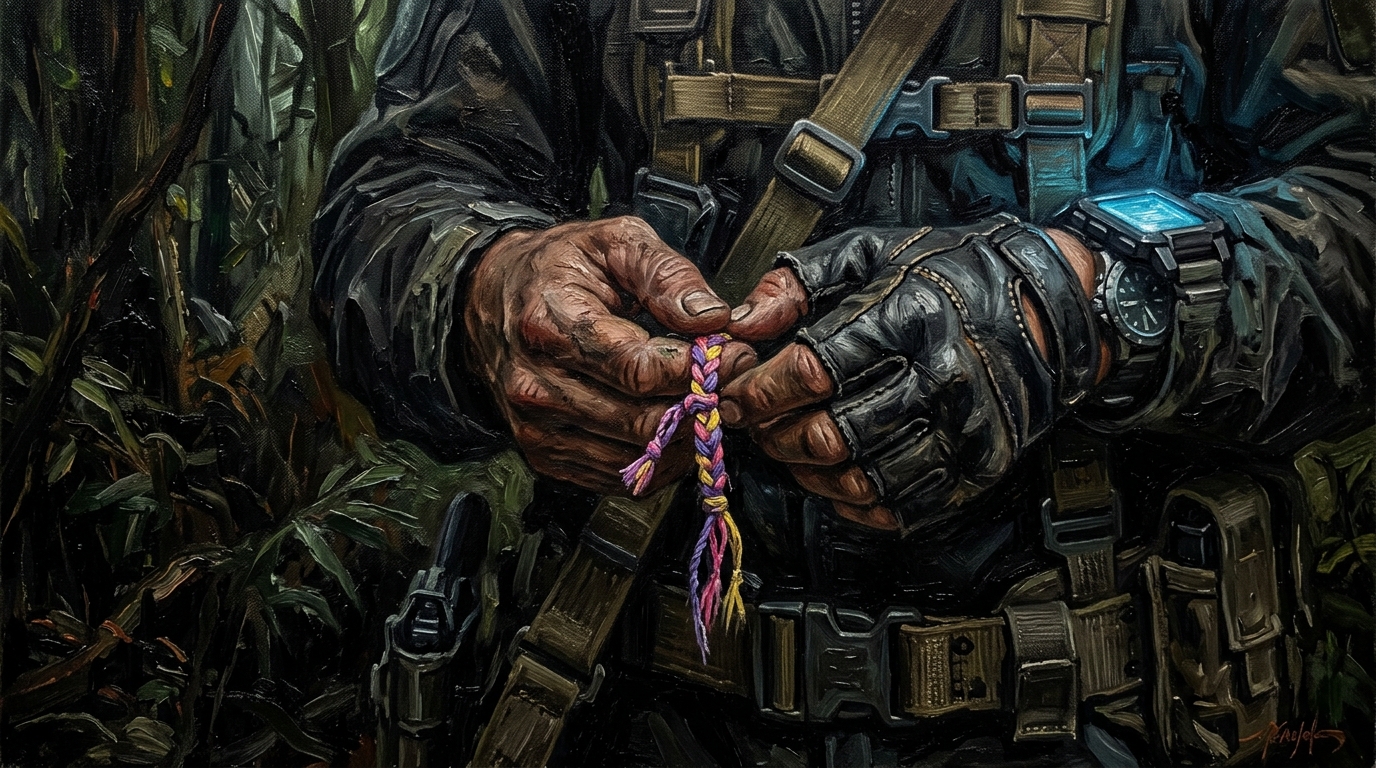
Deck pauses on the beach with the friendship bracelet hidden beneath his glove.
He stood. Shouldered the pack. Adjusted the straps once.
Twelve miles of jungle between him and a television crew that thought the most dangerous thing on this island was a jaguar. He ran the threat matrix the way he always did—fast, dispassionate, honest. The scientists were nothing. The medic was nothing. The woman who blogged about her makeup routine from a jungle was less than nothing. The producer watching screens in a city three thousand miles away couldn’t help them even if she knew he was coming.
Herrera was the only real threat.
Former Special Forces meant he’d been trained by the same machine, spoke the same language, understood the same math. A man like that didn’t just react—he anticipated. He’d feel the geometry of an ambush before it closed, read a tree line the way a conductor reads a score. Herrera was the kind of problem you solved first, fast, and without half-measures, because if you gave him a window he’d put you through it.
Then there was the AI. Not a threat the way Herrera was a threat—it wouldn’t fight him, wouldn’t shoot back—but autonomous surveillance platforms with thermal imaging didn’t sleep, didn’t blink, didn’t get bored on watch. And the one designated Gunther appeared to operate outside standard programming parameters in ways the briefing file had flagged but not explained. That made it unpredictable. Herrera he understood. The AI was something else.
The briefing had been specific about one thing. If the structure was real—if what Calloway’s team believed was out there was actually out there—then containment was the only acceptable outcome. Full containment. The briefing hadn’t used the word eliminate. Briefings never did. But he’d read enough of them to know what full containment meant when applied to a list of six names and no extraction order.
He’d sat with that for a while, the night before insertion. Not long. Just long enough to look at it clearly, the way he looked at everything—straight on, no flinch, no negotiation. Four people in a jungle. A man who built machines that thought for themselves. An archaeologist. A medic. A soldier who’d served the same flag he had. The two in New York were someone else’s problem—the same way the building was someone else’s problem. He didn’t need to know who. He just needed to know it was covered, and it was.
He was prepared to do his part. All four, if it came to that. He’d made that decision before he’d packed the bag.
He looked up at the jungle. Dark, patient, indifferent to whoever thought they owned it.
He didn’t radio anyone. He didn’t speak. He walked into the tree line without looking back, and within seconds the jungle closed behind him like it had never opened at all.
Fifty meters in, he stopped.
The nav screen was clean. No signatures, no movement, nothing on thermal. But the hair on the back of his neck was up, and that wasn’t a sensor he’d ever learned to ignore. Something was watching him. He held still for a ten-count, breathing through his nose, letting his eyes adjust to the deeper dark. Scanning the canopy. The undergrowth. The spaces between.
Nothing. Just jungle.
He filed it, the way he filed everything, and kept moving. But the feeling didn’t go away. It followed him — patient, unhurried, keeping pace — for the next two miles before it finally faded.
He never saw what it was.
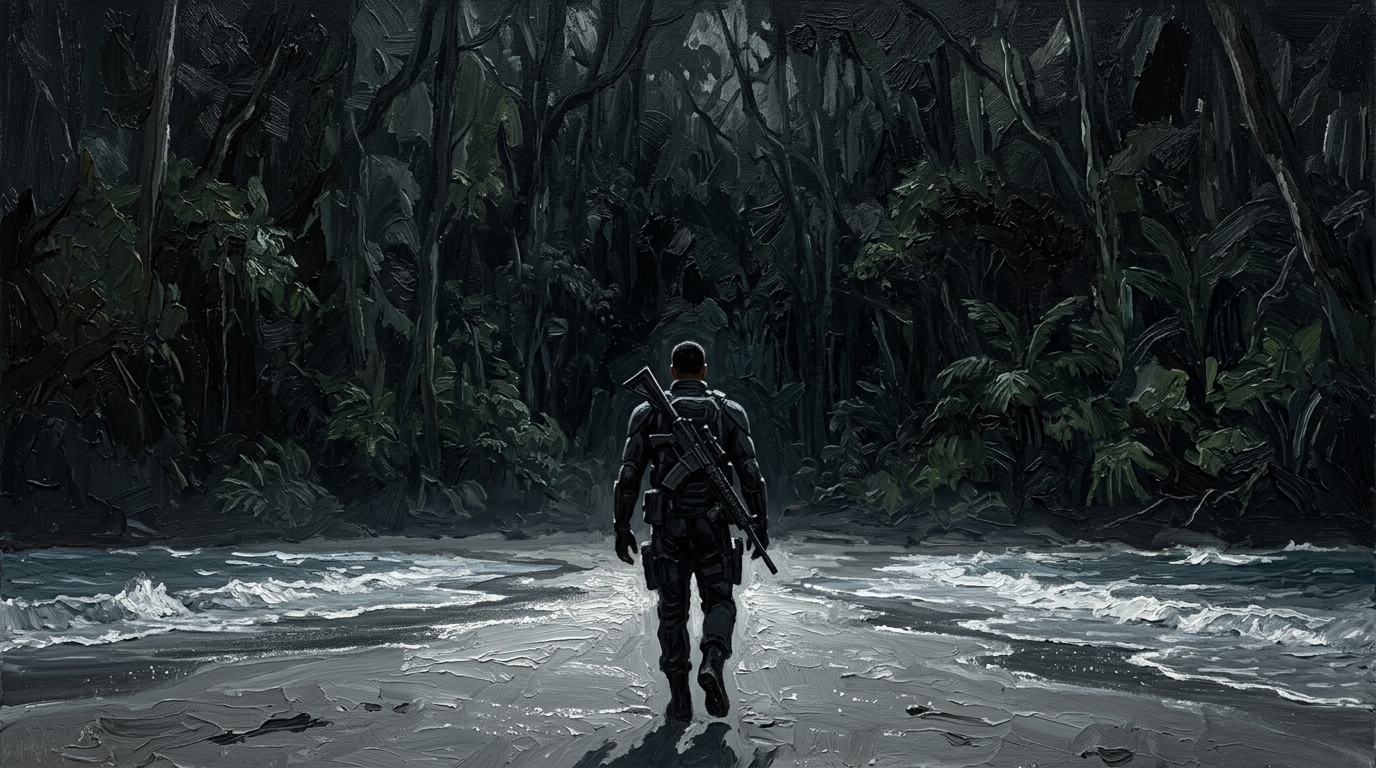
Deck disappears into the jungle wall alone.
0 Comments